One of the first things we do when a patient checks in is obtain vitals, the TPR: temperature, pulse, and respiration.
Respiration is easy. Half the time, a dog’s is charted simply as “panting.” Pulse is straightforward too, as long as you can actually touch that fractious cat. If you can’t, you wait for a better moment and probably end up documenting >200 bpm anyway.
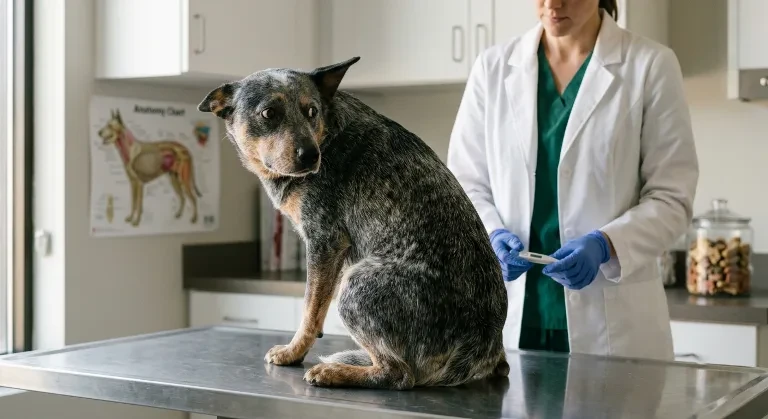
Temperature is a different story. It’s the moment when the shih tzu who has been your best friend all morning decides that treats are no longer worth tolerating the procedure.
Rectal Is the Gold Standard, but Not Every Patient Needs It
Rectal temperature is the reference standard for clinical temperature in veterinary medicine, and for good reason. In a study comparing three methods against a pulmonary artery catheter in dogs, rectal thermometry came closest to true core temperature across hypothermic, normal, and hyperthermic states (Greer et al., 2007).
For emergency patients and temperature-dependent treatment decisions, use your veterinarian’s established confirmation protocol. But does the healthy 4-month-old puppy coming in for a vaccine booster really need a rectal temperature? Or can we accept a less invasive method that keeps patients comfortable and more willing to tolerate the rest of their visit?
With cats, the math becomes a no-brainer. Cats notoriously object to rectal temperatures; as the rulers of their households, they are far too distinguished for that method. The objection is clinical, too: restraint and handling can add stress, and a study comparing axillary and rectal thermometry found that the axillary method generally required less handling and procedure time (Beyer et al., 2023). The 2022 AAFP/ISFM Cat Friendly Veterinary Interaction Guidelines support less invasive temperature assessment for apparently healthy cats and recommend leaving rectal measurement until later in the examination when it is needed.
Ear thermometers for pets exist, and they have their place. But the dog with ear infections four times a year will absolutely object to something sitting in that ear long enough to get a reading. Additionally, in a study of 300 dogs, the gap between auricular and rectal readings was judged clinically unacceptable (Konietschke et al., 2014).
Different Body Sites, Different Numbers
A microchip and a rectal thermometer measure two different places, so their readings won’t always match. A temperature microchip reads the tissue around the implant just under the skin, while a rectal thermometer reads closer to core body temperature. The implant site and the patient’s condition can all affect the gap (UID).
In a 2024 study of 120 cats, microchip readings averaged just 0.1°C (0.2°F) below rectal readings, a difference the researchers considered clinically unimportant (Goig et al., 2024). Most of those cats had normal temperatures, and the study used a different chip system than TraqPaw. See the study notes for the population limits and findings from dogs.
What 0.1°C Accuracy Really Means
Unified Information Devices (UID) verifies its TraqPaw Temperature microchips and PetScan URH-2-ISO reader together to a tolerance of ±0.1°C (about ±0.2°F) in internal water-bath testing. (UID).
UID verifies TraqPaw Temperature and PetScan URH-2-ISO together to ±0.1°C.
That figure describes laboratory accuracy: how closely the tested chip-and-reader pairing reads a known, controlled temperature. It does not mean an implant-site reading will always fall within 0.1°C of rectal temperature. Understanding body sites tells you how to interpret a reading from a patient.
UID verifies TraqPaw Temperature with PetScan URH-2-ISO as a system. A temperature microchip sends raw data, and each reader converts it with its own algorithm, so the same chip can display different temperatures on different readers. A reader that reads ISO ID numbers may not read temperature at all (UID).
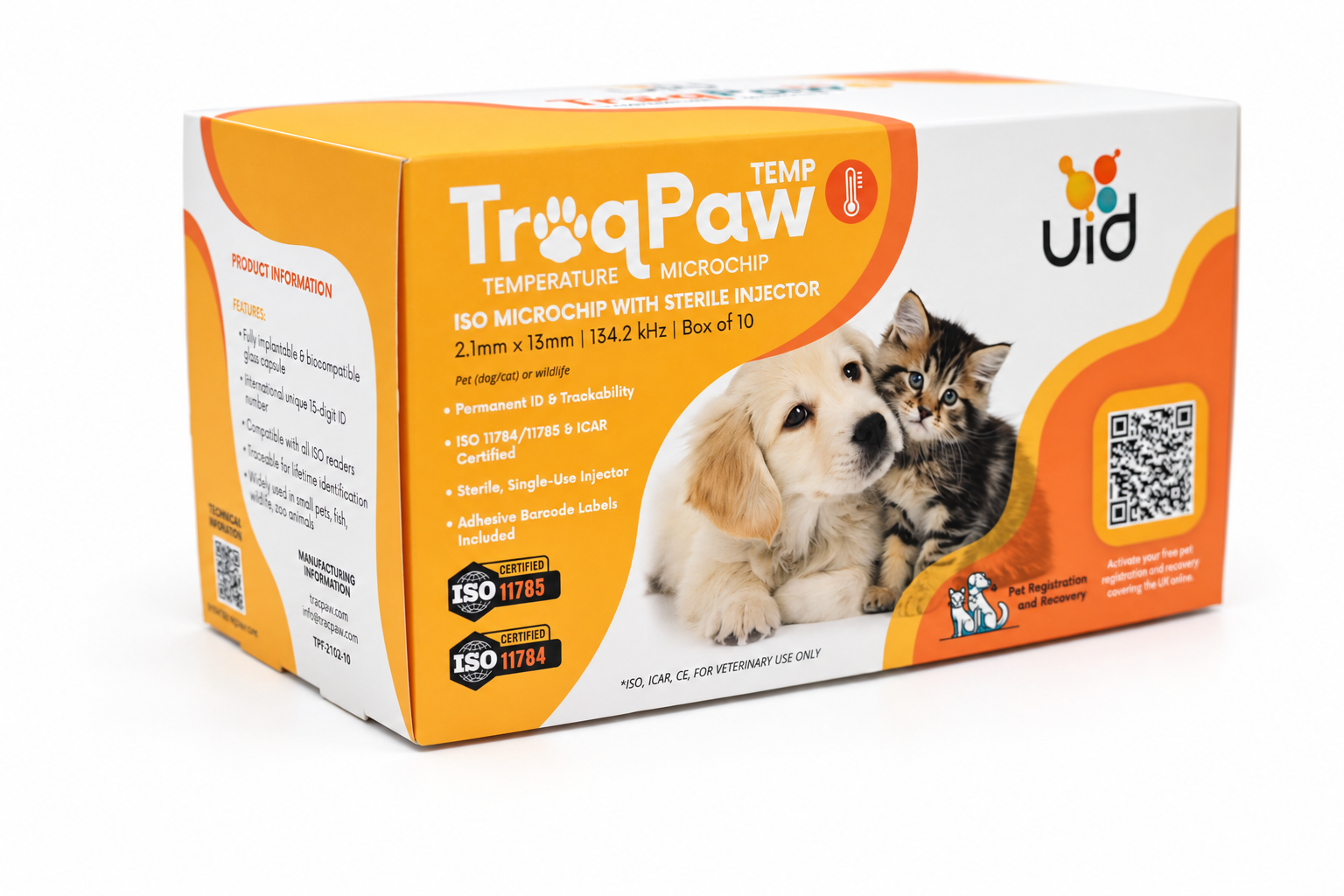
TraqPaw Temperature comes in two sizes: the standard TPT-2112 (2.1 × 13 mm) and the TraqPaw Mini Temperature TPT-1410 (1.4 × 10 mm). Like every TraqPaw chip, both use the ISO 11784/11785 FDX-B format, come preloaded in a sterile single-use injector, and arrive pre-registered to your clinic (UID).
The Cat in the Carrier and the Dog Who Won’t Hold Still
This is where microchip temperatures earn their place. Cat Friendly approaches aim to reduce fear, anxiety, and stress at every step of the visit, including letting cats come out of their carrier on their own rather than being pulled out (2022 AAFP/ISFM Guidelines). A microchip temperature fits right into that approach.
The stressed cat. Microchip readers work at close range, so when the cat is resting near the side of the carrier, try gliding the reader along the outside, over the shoulders. If the implant is within reading range and the carrier allows the signal through, you can obtain an ID and a temperature before the cat has to come out.
The dog who keeps backing away. Hand the scanner to the pet parent. Their dog already trusts them, so they can scan over the shoulders during a cuddle and hand the reader back. Easy, and it can help keep your relationship with that patient intact for the vaccine that comes next.
The benefits can build over time. Avoiding unnecessary restraint for a routine temperature check can help a patient tolerate the rest of the exam and build a calmer experience for the next visit.
Using Microchip Temperatures with Confidence
Microchip temperatures work best with a clear protocol your whole team follows, but here are some ideas worth considering:
- Use the scan for routine checks. Wellness exams, vaccine visits, and pre- and post-procedure checks in stable patients can be appropriate uses under your veterinary team’s protocol.
- Confirm when it counts. For temperature-dependent treatment decisions, or if a reading is out of range or the patient is ill, in shock, or in an emergency, follow your veterinarian’s established confirmation protocol, such as rectal thermometry. Your veterinarians set the thresholds.
- Use a verified pairing. Pair TraqPaw Temperature chips with the PetScan URH-2-ISO, and confirm temperature compatibility before trying any other reader.
- Scan consistently. Scan over the implant site the same way each time, and note the method in the record so readings can be compared across visits.
- Watch the trend. Comparing a patient’s readings over time, taken the same way, is often more useful than any single number.
Precision Plus Understanding
For the healthy puppy, the anxious cat in the carrier, and the dog with sore ears, a TraqPaw Temperature scan gives you a reading from a chip-and-reader system verified to ±0.1°C in UID’s water-bath testing, tied to the patient’s ID, with less handling. Pair that precision with an understanding of how body sites differ, and you can take the T in TPR with confidence and a happier patient.
Pet parents: if your pet has a temperature microchip, ask your veterinary team whether it can be used for routine temperature checks at your next visit.
About the Author
Weronika Shore, CVT, is a veterinary products specialist at Unified Information Devices. A certified veterinary technician with more than 12 years of experience in small animal and exotics practices, she has worked across reception, technician workflows, and practice management. She is passionate about the human–animal bond and using technology to improve efficiency, accuracy, and compliance in veterinary medicine.
Sources
- Beyer O, Lueck A, Brundage C. Comparison of axillary versus rectal temperature timing in canine and feline patients. Vet Sci. 2023;10(7):475.
- Goig M, Godino J, Tejedor MT, Burgio F. Correlation of temperature-sensing microchip and rectal temperature measurements in cats. Front Vet Sci. 2024;10:1319722. Study note: Most cats had normal temperatures; evidence in patients with a fever or hypothermia remains limited. This study was funded by MSD Animal Health and used a different chip system than TraqPaw.
- Greer RJ, Cohn LA, Dodam JR, Wagner-Mann CC, Mann FA. Comparison of three methods of temperature measurement in hypothermic, euthermic, and hyperthermic dogs. J Am Vet Med Assoc. 2007;230(12):1841–1848. Study note: In this small study of dogs, microchip readings tended to run lower than true core temperature. Rectal thermometry remained the closest of the three methods to core temperature, supporting confirmation when a reading looks abnormal.
- Konietschke U, Kruse BD, Müller R, et al. Comparison of auricular and rectal temperature measurement in normothermic, hypothermic, and hyperthermic dogs. Tierarztl Prax Ausg K Kleintiere Heimtiere. 2014;42:13–19.
- Rodan I, Dowgray N, Carney HC, et al. 2022 AAFP/ISFM Cat Friendly Veterinary Interaction Guidelines: Approach and Handling Techniques. J Feline Med Surg. 2022;24(11):1093–1132.
- UID. Pet microchips for veterinary practices.
- UID. Temperature microchips for dogs and cats.