
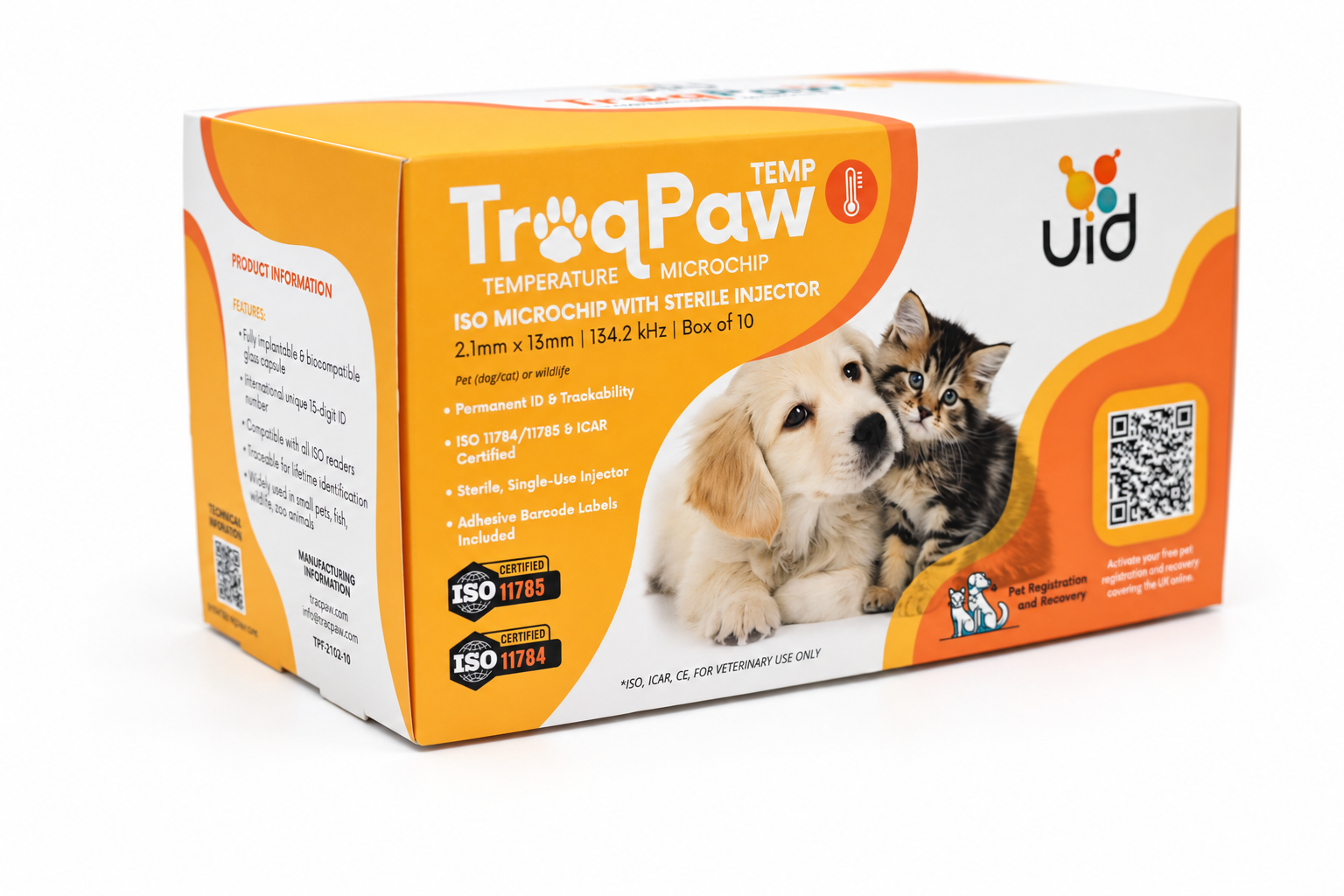
What Is a Temperature Microchip?
A temperature microchip combines RFID identification with a temperature sensor in one implant. A compatible reader retrieves the chip number and temperature together. The sensor measures temperature at its implantation site under the skin.
After implantation, the practical benefits are straightforward:
- Scan-based readings — collect a temperature by scanning over the implant site.
- ID and temperature together — confirm the patient and record the reading against the scanned microchip number.
- Built for the routine exam — take temperature at wellness visits, vaccine appointments, and physicals without a rectal probe.
- Easier repeat checks — scan before and after procedures with less handling than repeated rectal measurements.
Implantation is a veterinary procedure. Once a chip is in place, your team can make the scan the standard temperature step and use another method when a reading needs confirmation.
Temperature Microchips vs. Rectal Probes
Both provide a temperature measurement at the time of the check. A temperature microchip turns each routine check into a scan; a rectal probe requires insertion every time.
| Consideration | Temperature Microchip Scan an implanted sensor | Rectal Probe Take a rectal measurement |
|---|---|---|
| Measurement site | Subcutaneous implant site | Rectum |
| Each temperature check | Compatible reader scan | Probe insertion |
| Initial procedure | Microchip implantation | No implanted sensor |
| Animal identification | ID + temperature | Separate patient association |
| Equipment compatibility | Tag-specific temperature support | Probe compatibility |
Is Microchip Temperature the Same as Rectal Temperature?
They measure at different sites, and the difference matters most when a patient's temperature is abnormal. Subcutaneous and rectal temperatures can differ with the animal's condition, implant location, and environment.
For routine checks, the published evidence is encouraging. A clinical study in cats found promising agreement between microchip and rectal measurements, primarily in cats with normal temperatures — the typical wellness-exam patient. Individual readings still differed, and the authors called for further study under other conditions.
Away from normal temperatures, rectal measurement remains the reference. A study in dogs across different temperature states found rectal measurements agreed more closely with core temperature than subcutaneous microchip readings. These studies used other systems; they provide context for interpreting the method.
A practical protocol: use the scan as the temperature step in physicals and pre- and post-procedure checks, and confirm with a rectal or other measurement when a reading is out of range or the patient's condition calls for it. Your veterinary team sets those thresholds.
Why Doesn't Every ISO Reader Read Temperature?
Reading the ID is one capability. Reading temperature is another. An ISO FDX-B identification reader can read a compatible TraqPaw chip's number without supporting its temperature data.
ISO 11784 defines the animal identification code. ISO 11785 defines transponder activation and communication. An ISO identification claim alone does not confirm temperature support or temperature accuracy.
Before choosing a reader, check three things:
- Identification format — does it read the chip's ISO FDX-B ID?
- Temperature support — does it support that specific temperature transponder?
- Tested pairing — how has the reader's temperature result been verified with that tag?
See our ISO pet microchip guide for identification formats and scanner selection.
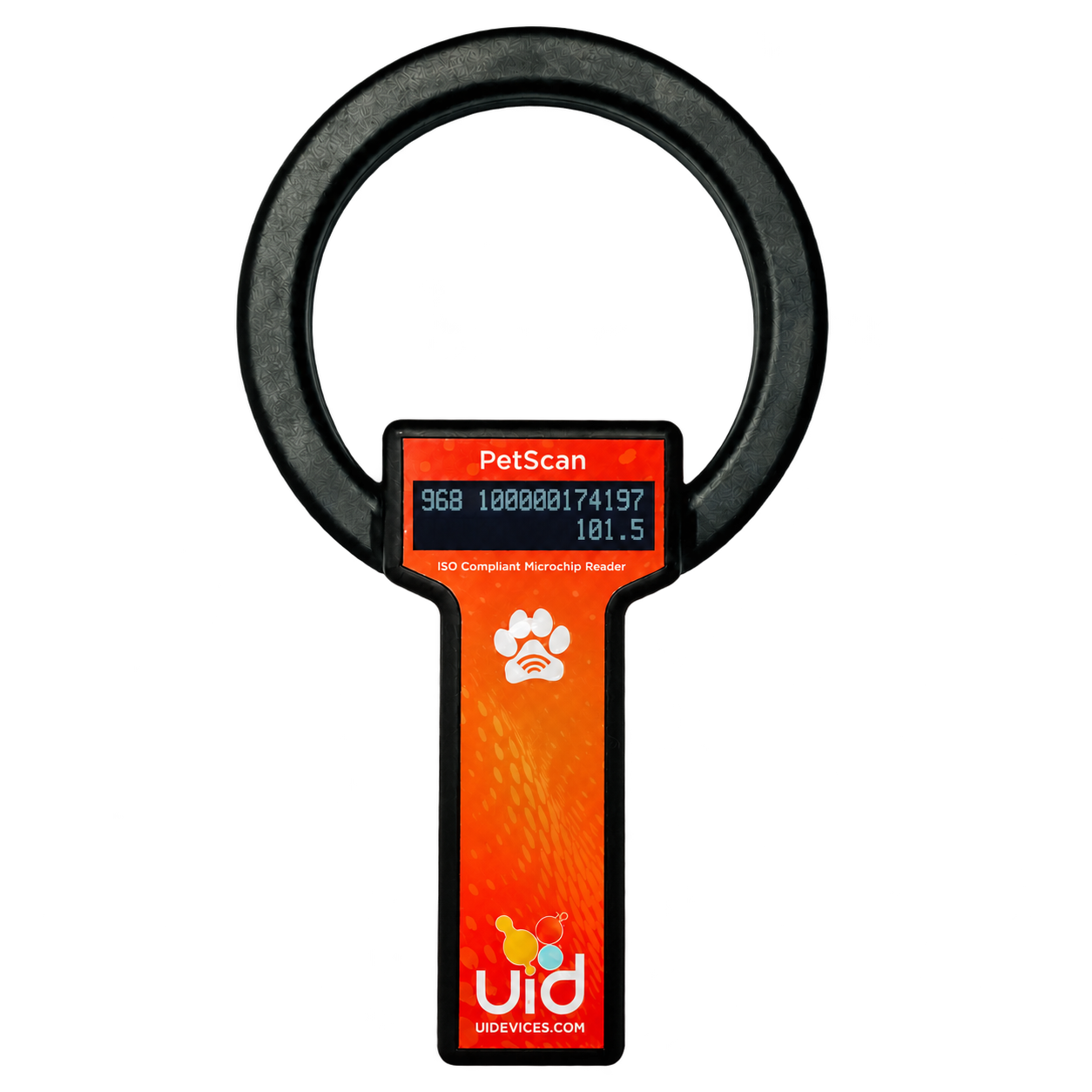
Why Use PetScan for TraqPaw Temperature?
PetScan URH-2-ISO reads identification and temperature from both TraqPaw Temperature sizes. Its temperature algorithm interprets the tag's temperature data, so the reader is part of the measurement system. Testing the complete pairing checks the result produced by the sensor and UID's reader algorithm together.
Third-party reader and tag combinations can deviate. A temperature tag returns raw data, and each reader applies its own algorithm to convert that value into a displayed temperature, so the same tag can produce different results on different readers.
TraqPaw Temperature Tags and Reader
Both temperature microchips include a sterile single-use injector and barcode labels. Your veterinary team should choose the implant size for the patient.
-
TraqPaw Temperature
TPT-2112. A 2.1 x 13 mm ISO microchip for identification and temperature. Supplied in boxes of 10.
-
TraqPaw Mini Temperature
TPT-1410. A smaller 1.4 x 10 mm ISO microchip with the same identification and temperature functions. Supplied in boxes of 10.
-
PetScan URH-2-ISO
The veterinary reader for ID and temperature from both TraqPaw Temperature sizes. Confirm temperature compatibility before using another reader.
Standards, Studies, and Product Details
Identification standards: ISO 11784:2024 — code structure and ISO 11785:2026 — technical concept.
Clinical method studies: Goig et al., 2024 — temperature-sensing microchips and rectal measurements in cats; Greer et al., 2007 — three temperature measurement methods in dogs. These studies evaluated other chip-and-reader systems and do not validate TraqPaw or PetScan performance.
UID testing: The 0.1°C statement describes UID's internal water-bath verification of its readers with its tags. Contact UID to discuss test conditions for your pairing.
For research workflows, see animal temperature monitoring methods. For veterinary identification, compare TraqPaw microchips and pet microchip scanners.
Temperature Microchip Questions
-
Can a temperature microchip replace a rectal thermometer?
For routine checks, a scan can serve as the temperature step in a physical or pre-procedure workup. The sensor measures at its implant site, so confirm with a rectal or other measurement when a reading is abnormal or the patient's condition warrants it.
-
Does every ISO microchip reader read temperature?
No. ISO identification compatibility does not establish temperature compatibility. A reader may display the microchip number while lacking support for that tag's temperature data. PetScan URH-2-ISO reads both from TraqPaw Temperature tags.
-
How does UID verify temperature accuracy?
UID verifies its readers and tags together to 0.1°C using internal water-bath testing. This evaluates the reader-and-tag temperature result under the test conditions. It does not mean the implant-site reading will always be within 0.1°C of rectal temperature.
-
Why does the reader matter for temperature accuracy?
The reader must support the tag and interpret its temperature data correctly. PetScan uses UID's temperature algorithm. Testing the reader and tag together checks the resulting measurement; displaying a decimal place alone does not establish accuracy.
-
Will an ordinary ID microchip provide temperature?
No. The implanted chip must include a temperature sensor. An identification-only microchip cannot gain temperature sensing by changing readers. Choose a temperature-capable chip and a reader that supports it.
-
Which URH-2 should our practice use?
Use PetScan URH-2-ISO for TraqPaw Temperature TPT-2112 and TPT-1410. The research URH-2 is configured for UID research microchips. Confirm the reader configuration with UID when ordering or checking an existing unit.
Choosing Temperature Microchips for Your Practice?
Tell us about your patients and the reader you already use. We'll help you choose the tags, confirm the pairing, and discuss the applicable test conditions.