
A syringe was never a measuring instrument.
Syringes are built and calibrated to administer a dose, not to account for one. On the small partial draws a study protocol runs on, the markings drift further from the true volume than most facilities realize, and that drift is what shows up as a discrepancy in the controlled-drug record.
What the tolerance actually looks like
- ±4% Syringe accuracy at full nominal volume (ISO 7886-1)
- Up to 15% Measured error at one-tenth of a syringe's capacity (Journal of Medical Devices, 2018)
- 0.45–0.55 mL What a "0.5 mL" draw on a 5 mL syringe can actually be
Where the drift comes from
A syringe is calibrated at one point: full volume. Everything below that drifts, and most controlled-substance doses in the facility live well below it.
- Full draw: accurate to ±4% (ISO 7886-1). One-tenth draw: off by up to 15%.
- Research doses are mostly partial draws, weight-based and rodent-scale (controlled substances such as buprenorphine and ketamine), right in the range where the drift is worst.
- Multi-dose vials and mixed syringe sizes stack the drift dose after dose, across every research tech on the protocol.
- The record has to cover four numbers: administered, removed, wasted, remaining. The drift throws off all four.
So the log says 0.5 mL, the vial actually lost 0.6, and at the biennial count or a DEA inspection, an honest record reads like a discrepancy.
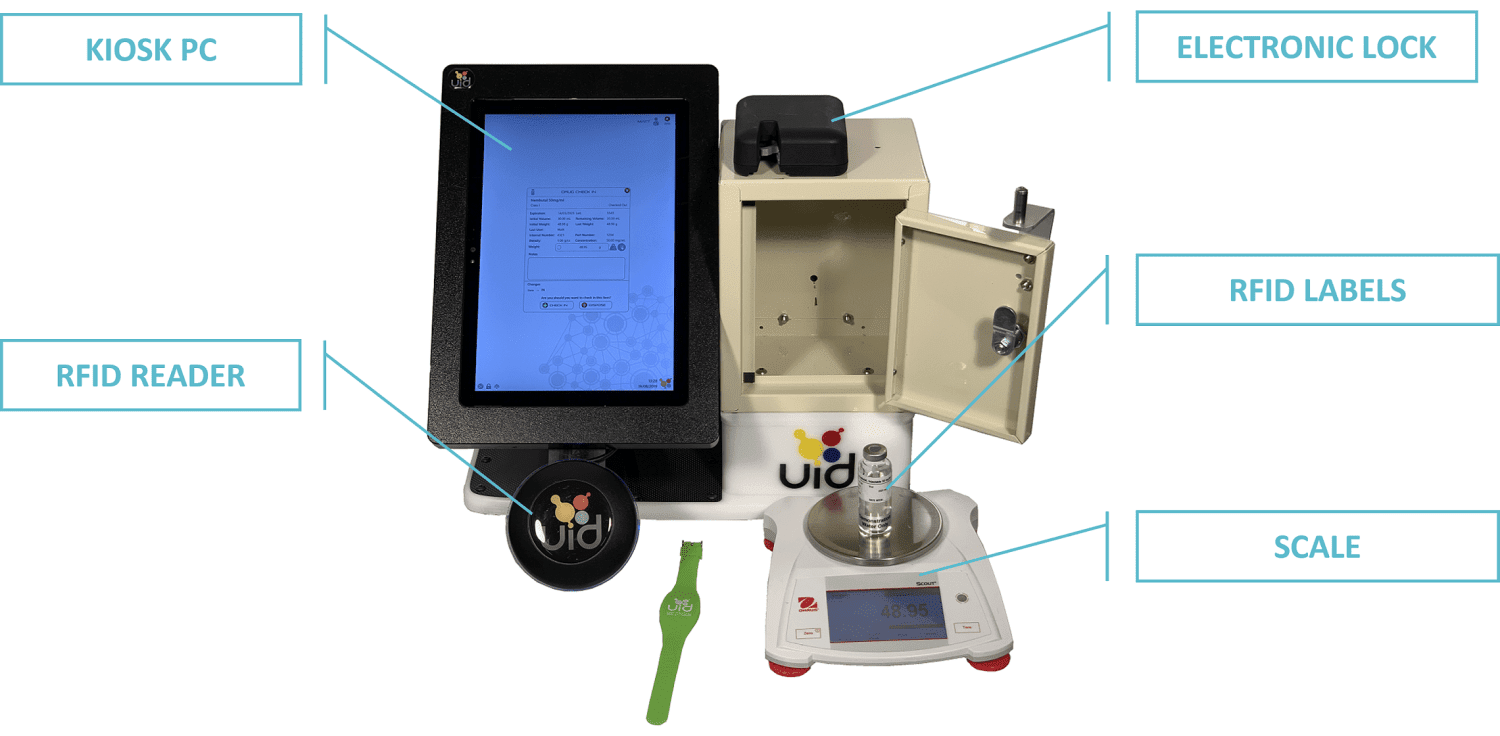
Here's the training point: the drift is normal. Nobody drew the dose wrong; the instrument was never built for partial-volume accounting. The CSI-360 is designed around exactly this — it expects the drift, weighs the vial instead of trusting the syringe, and the record stays reconciled without anyone having to explain a 0.1 mL gap.
Weigh, don't estimate
-
Weigh the vial before
The vial goes on the scale before the dose is drawn, capturing its starting weight.
-
Draw the dose as usual
The research tech draws the dose the same way they always have, with no new technique to learn.
-
Weigh the vial after
The vial goes back on the scale. The system captures the weight difference.
-
Convert weight to volume
The weight difference converts to a volume using the drug's own specific gravity. A morphine vial that drops from 10 g to 9.8 g tells the system exactly how many mL came out, independent of what the syringe reads.
-
Log it automatically
The dose logs against the intended amount without a handwritten entry, hub loss included.
How the CSI-360 applies this
The CSI-360 puts this weigh-before, weigh-after method at the point of dispense. The digital scale captures both weights; the software does the specific-gravity conversion and writes the result to the record automatically, with no separate accounting step for the tech to remember.
Hub loss, the small amount of drug left behind in the needle hub, varies by needle gauge and length, and estimating it is its own source of accounting drift. Because the CSI-360 weighs the vial itself rather than estimating what left it, hub loss is accounted for in every dose, not guessed at after the fact.
- Drift is expected — syringe tolerance is normal physics, and the system is built around it; the weighed record absorbs the drift instead of turning it into a discrepancy.
- Same technique, better record — the tech still draws the dose the usual way; the cabinet does the accounting.
- Hub loss included — accounted for per dose, not estimated once and applied everywhere.
Syringe markings vs. weighed dispensing
| Syringe markings | Weighed (CSI-360) | |
|---|---|---|
| Calibrated at | Full volume only | Every dose |
| Partial doses | Drift up to 15% | Measured by weight |
| Hub loss | Estimated | Calculated per dose |
| Log entry | Written by hand | Logged automatically |
| At audit | Explain the drift | Already reconciled |
Common questions
-
Is this a technique problem with my research technicians?
No. This is a tolerance built into the syringe as an instrument, not a mistake your techs are making. The drift shows up no matter how careful the person holding it is, and it's completely normal: the CSI-360 expects it, and the vial gets weighed, so the record never depends on the syringe.
-
Which draws drift the most?
Small volumes drawn on a larger syringe. The one-tenth-of-capacity case is where the 2018 study measured its worst error, up to 15%. Most research dosing lives in exactly that range, which is why the drift matters more in the vivarium than at full-vial volumes.
-
What is hub loss?
The small amount of drug left behind in the needle hub after a dose is drawn. It varies by needle gauge and length, and estimating it, rather than measuring it, is its own source of accounting drift over time.
-
Should we stop using syringes?
No. Syringes remain the right tool for administering a dose. The point isn't that syringes are bad; it's that they were never designed to double as a measuring instrument for partial-volume accounting, which is a different job.
-
How does the CSI-360 apply this?
It weighs the vial before and after the dose, converts the weight difference to volume using the drug's specific gravity, and logs the result automatically, hub loss included. See the CSI-360 product page for the full system.
References
- Syringe accuracy standard: ISO 7886-1 (paid standard; cited by name, no public link).
- Partial-draw error study: Journal of Medical Devices, 2018 (cited by name; no verified public URL).
Bring the log and the vial back into agreement.
If your controlled-drug record has ever carried a discrepancy you couldn't fully explain, this is usually why. Give us a call and we'll walk through how the CSI-360 applies weight-and-density measurement at your cabinet.