
Choosing an Animal Temperature Monitoring Method
Start with the record your study needs. A scheduled reading, a temperature microchip scan, and a continuous home-cage record answer different questions about change over time.
Choose the Measurement Pattern First
-
A Reading at a Known Time
Scheduled checks provide a value at each observation. Consider how the reading is associated with the animal and how staff capture the result.
-
A Record Between Checks
Continuous monitoring captures repeated measurements over time, including periods when staff are away from the cage. Plan for the data record as well as the reader.
-
Temperature with Other Context
If the study also needs individual activity or location, evaluate those as separate measurement capabilities. The monitoring system determines which additional signals are available.
Compare Three Temperature-Collection Approaches
This is a method-selection overview. Choose the measurement site, equipment, and animal-care procedures with your facility's veterinary and research teams.
| Feature | Rectal Thermometer Manual temperature measurement | Handheld RFID Reader Read a temperature microchip | Home-Cage Monitoring Continuous RFID temperature readings |
|---|---|---|---|
| When is a value collected? | When staff take a measurement | When a compatible reader scans the chip | Repeatedly while the monitoring system is running |
| How is identity associated? | Through the animal record and entry workflow | Chip ID and temperature on the same read | Individual chip ID in the time-series record |
| What equipment is involved? | Rectal thermometer and record system | Temperature chip, reader, and capture workflow | Temperature chips, cage readers, and data collection |
| What happens between observations? | No additional record from that measurement | No additional record from that scan | The configured system continues collecting reads |
| What should be evaluated? | Measurement site, handling, and data entry | Placement, reader pairing, and repeatability | Cage fit, read coverage, animal ID, and data review |
| Where does UID fit? | Discuss how existing records will be used | UCT-2112 with a compatible research reader | AnyCage Lite, AnyCage+, or Mouse Matrix |
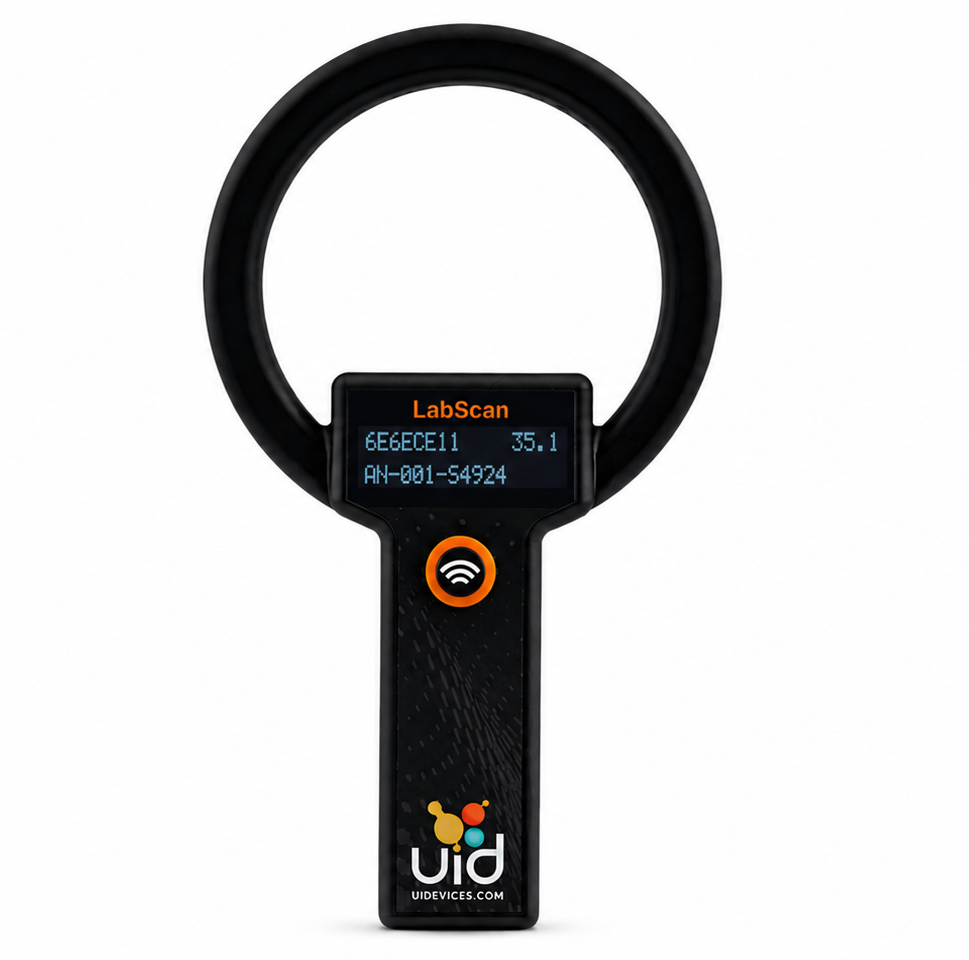
One Microchip for Identification and Temperature
The UCT-2112 temperature-sensing RFID microchip is a passive, battery-free transponder. A compatible UID research reader retrieves its identity and temperature together.
The same chip can support handheld spot checks and compatible home-cage systems. That gives a team a path from individual scans to repeated monitoring without choosing a different chip for each reading method.
The complete system matters. The reader and software collect the time series; a chip alone is not a standalone data logger. Activity and zone-location measurements come from the capabilities of the monitoring system.
Confirm the chip, research reader, and software as a set. A veterinary ISO identification scanner should not be assumed to read a research temperature transponder.
Match the System to the Data You Need
Once continuous RFID monitoring fits the study, choose the setup by scale, housing, and required measurements.
-
AnyCage Lite
USB-connected temperature monitoring for a smaller cage setup, with a PC-based data-collection workflow.
-
AnyCage+
Temperature monitoring across a larger cage setup, with controller-based collection and options for software review.
-
Mouse Matrix
Temperature, individual activity, and zone location for studies that need movement context alongside the temperature record.
Compare Like with Like
An animal temperature record depends on what is measured, where it is measured, and when. Review measurement location and method before treating values from different devices as interchangeable.
- Rectal thermometers are commonly used for individual temperature measurements. Each reading requires handling and probe insertion, which should be considered when planning repeated measurements.
- Implanted temperature sensors measure at the sensing location. Placement and the intended interpretation belong in the facility's method evaluation.
- Telemetry systems may support other physiological measurements, depending on the equipment. Compare the required signals and housing needs with the proposed RFID setup.
Select an approach with your veterinary and research teams. Repeated monitoring can add useful context, but it complements direct observation and animal care.
Four Decisions Before Choosing Hardware
-
Define the Record
Decide whether the study needs scheduled values or a time series, and whether identity, temperature, activity, or location must be linked.
-
Review Housing and Welfare
Discuss the animals, social housing, cage and rack arrangement, and the care implications of the proposed method with the facility team.
-
Check the Complete Pairing
Confirm chip compatibility, reader coverage, required connections, and the software that captures the data. Review the setup in the actual housing configuration.
-
Plan Data Review
Identify where records will be stored, who reviews them, which exports are needed, and how data gaps or observations will be documented.
Animal Temperature Monitoring Questions
-
Is an RFID temperature microchip a continuous monitor by itself?
No. A passive temperature microchip is read by compatible equipment. A continuous record requires the readers, power, connections, and data-collection software in a working monitoring system.
-
Can the same UCT-2112 chip be used for spot checks and home-cage monitoring?
Yes. UCT-2112 supports compatible UID research readers and the AnyCage Lite, AnyCage+, and Mouse Matrix systems. Confirm the reader and software pairing for your setup.
-
Does every temperature microchip measure activity?
No, the chip supplies identification and temperature. Mouse Matrix adds individual activity and zone-location information through its reader system and software. AnyCage Lite and AnyCage+ focus on temperature monitoring.
-
Does RFID monitoring require single housing?
No. All UID home-cage monitoring systems support group-housed animals, generally up to six per cage. Each animal is identified by its own microchip. Confirm the animals per cage, cage arrangement, and data requirements with UID.
-
Is implanted RFID monitoring non-invasive?
The microchip requires placement under an approved animal-care procedure. After placement, a compatible system can collect readings without repeated handling for each read. Consider the complete method with your facility's veterinary and welfare teams.
-
Which software collects and reviews the data?
The choice depends on the system and the task. DataCollector records supported reader scans to CSV; VivoTraq provides cloud review and analytics; Mouse Matrix App serves the Mouse Matrix workflow.
Continue Your Method Review
NC3Rs describes how automated animal monitoring can add temperature and activity information to welfare assessment, and discusses social housing during telemetry recordings.
For UID equipment, see the full home-cage system comparison, research software options, and our overview of animal welfare and the 3Rs.
Match the Monitoring Method to Your Study
Tell us about your housing, measurement needs, and existing data workflow. We'll help you compare the appropriate UID equipment and software.